Salary Guide / USA
USA CleanTech
Salary Guide 2026
Using data from over 20,000 candidates in the Storm4 database we have put together a comprehensive picture of CleanTech salary and remuneration trends in the USA. This guide will provide key insight into each CleanTech niche, discussing the local job landscape across the region.

Want more specific insights for your sector?
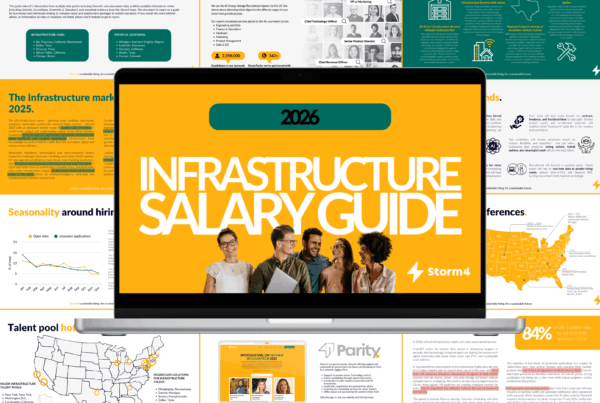
These comprehensive sector salary guides take a deeper look into valuable salary benchmarks, industry trends, and expert advice, tailored to each CleanTech niche. We use a mix of data we have collated from over 20,000 candidates and industry insights from our clients, to create reports relevant no matter your company size, location or seniority level!
US CleanTech Salary Guide 2026
From grid-scale batteries and AI-powered data centers to eVTOL aircraft and algorithmic power trading, the US CleanTech ecosystem has never been broader – or more talent-hungry than it is going into 2026.
Across the Clean Energy, Infrastructure and Mobility sectors there has been massive growth over the past few years, with the pace looking to stay high in 2026 and beyond as:
- The US energy storage market entered 2025 at around $138.6bn, with electricity demand forecast to rise 2.5% in 2025 and another 2.7% in 2026, putting huge pressure on grid infrastructure and next-gen generation.
- US infrastructure – from smart buildings to data-center campuses – represents roughly $1.9tn in construction and modernization spend, increasingly tied to AI workloads and electrified real-estate portfolios.
- The US EV market is estimated at ~$140bn in 2025, with public charging infrastructure moving from ~$5.09bn in 2024 to a projected $6.41bn, as fleets electrify and AI/data-center demand spills into mobility.
- North American power trading now sits at the heart of the energy transition, underpinning 4,191 billion kWh of wholesale demand and a fast-evolving mix of renewables, storage and conventional assets.
- SpaceTech and advanced aerospace – from launch and satellite platforms to eVTOL and autonomous flight – moved from proof-of-concept into early commercialization, backed by growing private capital and regulatory engagement.
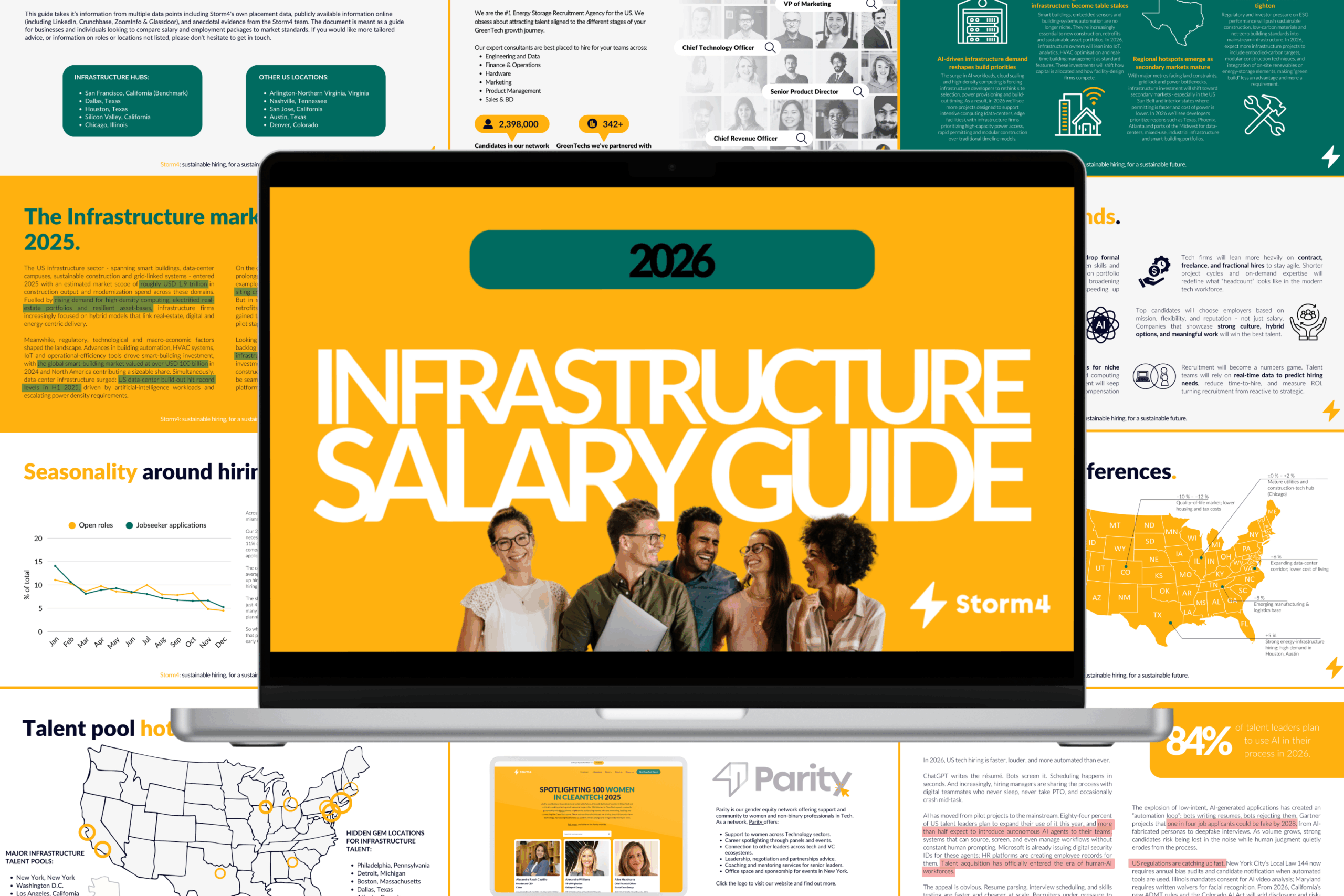
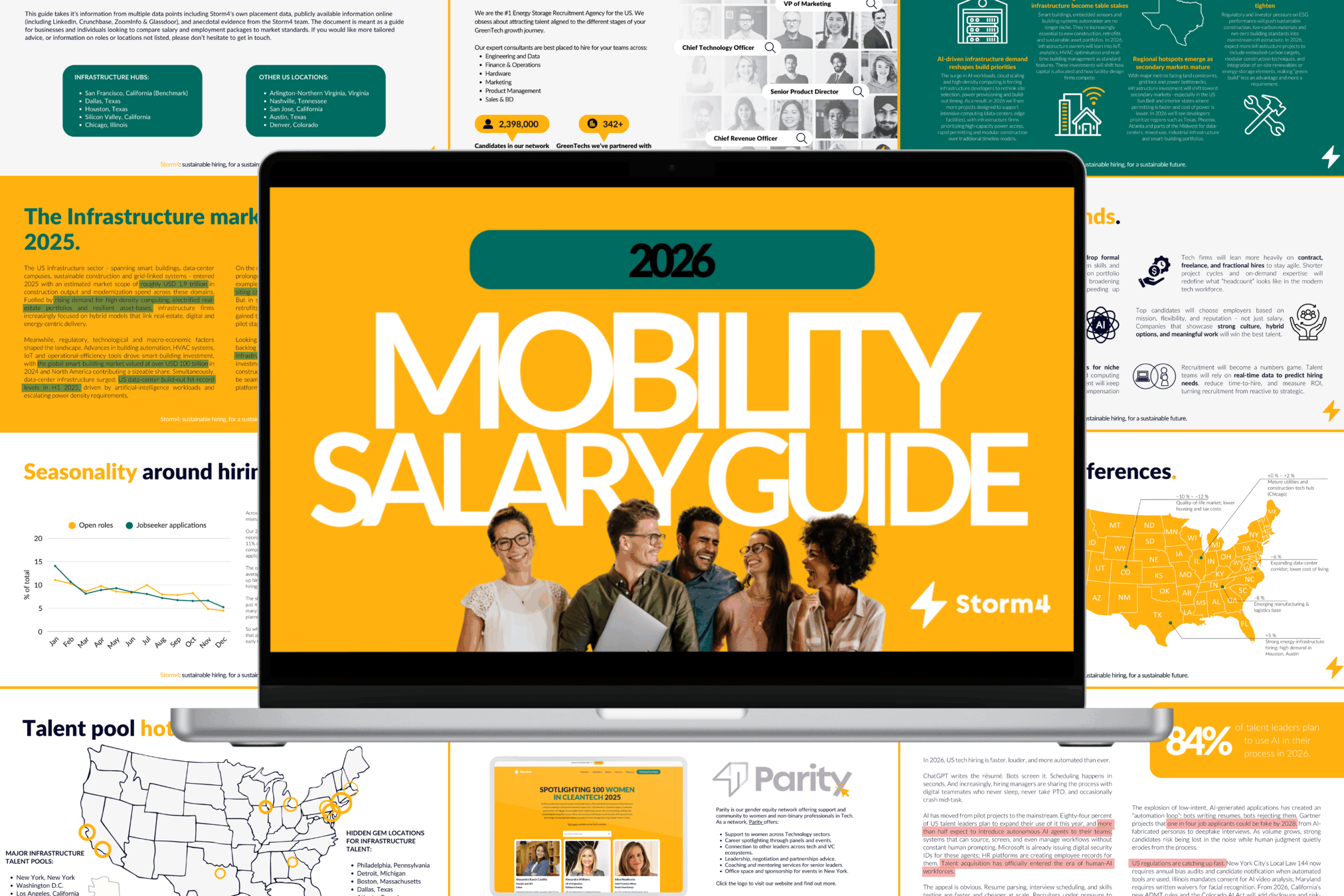
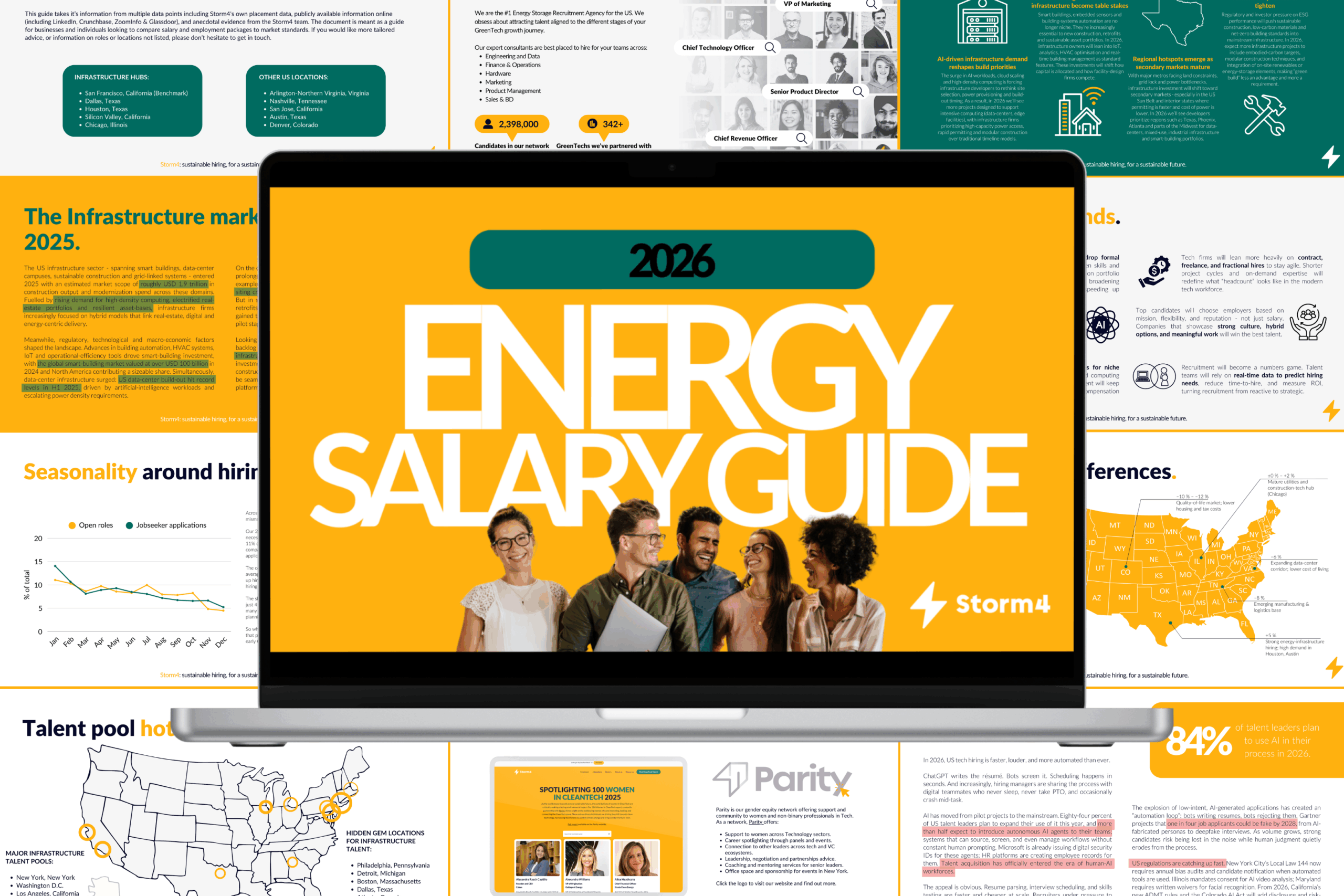
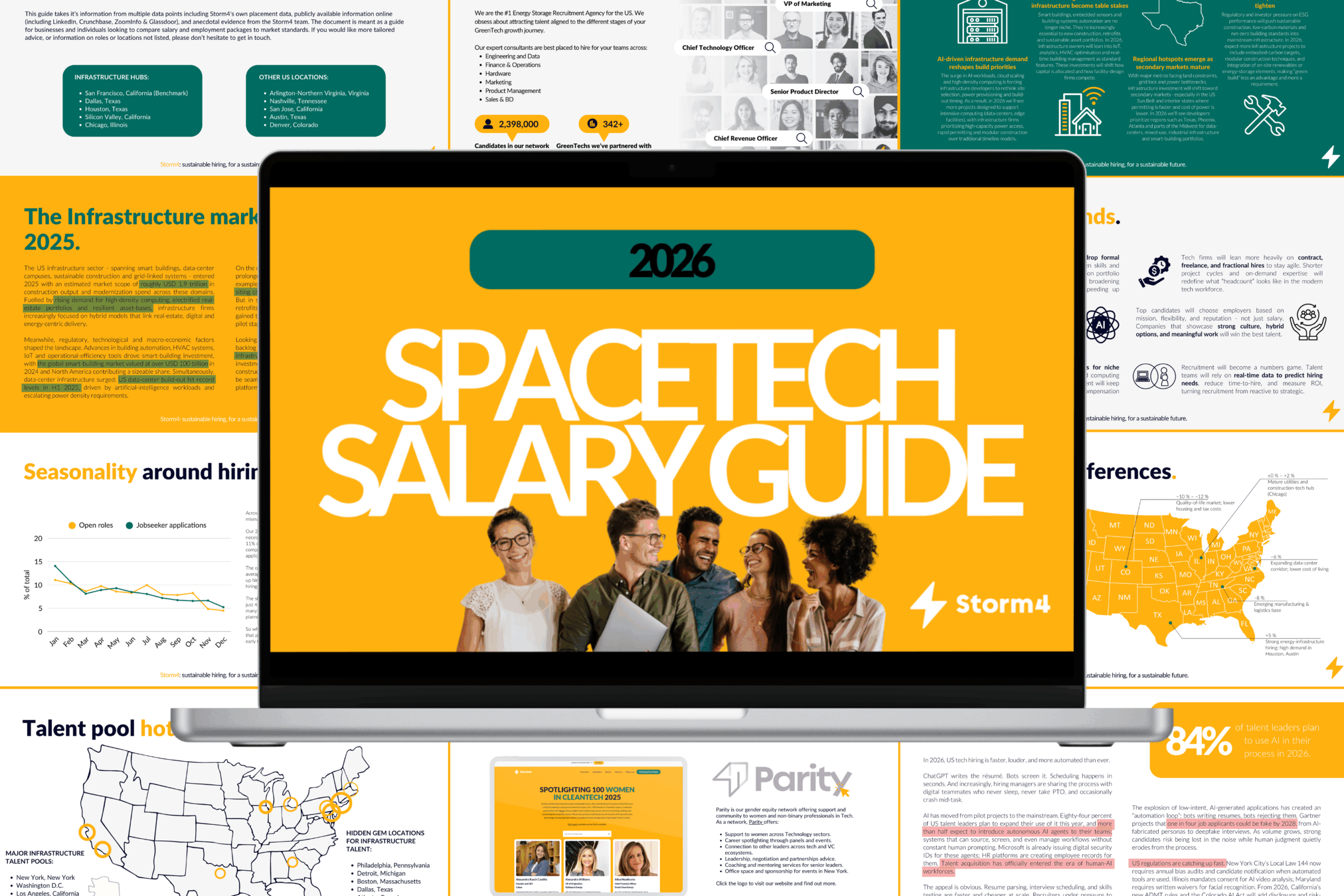
To help both employers and professionals navigate this landscape, we’ve released our US CleanTech Salary Guides for 2026 across five core pillars:
Each guide breaks down salary ranges, equity expectations and hiring trends by function and seniority – from IC engineers to C-suite.
How We Collected The Data
Our 2026 US CleanTech Salary Guide is built from multiple sources:
- Storm4 placement and shortlist data across Energy, Infrastructure, Mobility, SpaceTech and Power Trading
- Public information from platforms such as LinkedIn, Crunchbase, ZoomInfo and Glassdoor
- Live market feedback from hundreds of hiring processes run by Storm4 consultants across the US
This blended methodology means our CleanTech Salary Guide benchmarks reflect real offers and compensation conversations in 2026 – not just advertised ranges.
Below, we break down the market trends, salary insights, and hiring dynamics shaping the US CleanTech landscape in 2026 – with detailed analysis across the five sectors featured in this year’s Salary Guides.
Key CleanTech Market Trends in 2026
1. AI-Driven Demand Reshapes Energy & Infrastructure
Explosive power demand from data centers, AI clusters and high-performance computing is forcing a complete rethink of capacity planning. Regions like Texas, Northern Virginia and the Pacific Northwest are already reporting grid strain, with AI-enhanced forecasting and grid optimization moving to the center of utility strategy.
On the infrastructure side, AI workloads and cloud scaling are redefining where and how data-center and edge facilities are built, with developers prioritizing high-capacity power access, accelerated permitting and modular construction.
2. Next-Gen Nuclear and Domestic Manufacturing Step Up
2026 is a pivotal year for advanced and small modular reactors (SMRs), as multiple pilot projects move toward licensing or early construction – positioning nuclear as a complement to renewables rather than a competitor.
At the same time, IRA-driven incentives are accelerating domestic manufacturing of batteries, solar and grid components, with new production corridors emerging across the Midwest and Southeast.
3. Mobility Matures – EV Growth Pauses, Infrastructure Catches Up
After several years of exponential growth, US EV adoption is expected to stabilize around 9–10% of new vehicle sales in 2026 as incentives roll back and affordability tightens.
The focus shifts to infrastructure: with over 5 million EVs on US roads, 2026 brings accelerated investment into high-power public charging networks and uptime reliability – often through joint efforts between utilities, charge-point operators and OEMs.
4. SpaceTech & Advanced Air Mobility Move From Prototype to Operations
Urban air mobility and eVTOL platforms are edging toward limited commercial service, with several US developers targeting early operations and progressing through FAA milestones in 2026.
Alongside this, autonomous and connected mobility software – from perception stacks to fleet management – enters early commercialization in logistics, transit and last-mile delivery.
5. Power Trading Becomes a Core Climate Lever
Power trading has shifted from a supporting function to a core pillar of the US energy value chain, as traders manage volatility from renewables, BESS and load-flexibility solutions.
2026 marks:
- AI-enabled real-time trading moving from niche to standard
- Storage-backed virtual power plants monetizing capacity, ancillary services and arbitrage
- Conventional assets (gas, nuclear, hydro) gaining new value as dispatchable hedges against renewable volatility
CleanTech Hiring & Recruitment Trends in 2026
Across Energy, Infrastructure, Mobility, SpaceTech and Power Trading, the US CleanTech Salary Guide 2026 highlights several common themes:
1. Seasonality: Demand & Candidate Activity Don’t Match
Storm4’s 2025 recruitment data shows:
- January accounts for ~14% of total applications but only 11% of new job postings – candidates are active while many companies are still finalising budgets.
- June–September: open roles rise to 8–10% of the annual total, but applications drop to 7–8%, stretching time-to-hire.
- November–December: roles fall to 4–5% of annual postings while candidate interest holds around 7%, especially among those planning a January move.
In short: teams that hire when competitors are quiet win the best talent.
2. AI in Recruitment – Support, Not Replacement
- 84% of US talent leaders plan to expand AI use in recruiting in 2026, including autonomous sourcing and screening agents.
- Regulations in states like New York, Illinois, Maryland, California and Colorado are already requiring bias audits, consent and risk assessments for automated tools.
- Two-thirds of US adults say they would rather not apply for a role where AI helps make hiring decisions, and 71% oppose AI making the final call, putting a premium on transparency and human judgment.
The takeaway: AI can shortlist candidates; it can’t yet read ambition, resilience or cultural fit.
3. Skills First, Not Degrees First
By 2026, more tech and CleanTech employers are dropping strict degree requirements in favour of portfolios, certifications and demonstrated outcomes – widening access to non-traditional talent and speeding up hiring cycles.
4. Equity & Variable Compensation Get More Sophisticated
In Energy, Infrastructure and Mobility, equity is often delivered through phantom stock, profits interests or carry-style incentives, rather than pure stock options – especially for asset-heavy and project-finance structures.
In Power Trading, “equity” typically means profit participation and performance pools rather than cap-table ownership, tying upside directly to trading performance.
Candidates increasingly expect clear explanations of what they own, what it’s tied to, and how they get paid.
Sector Snapshots: Looking Ahead to 2026
Energy
The US Energy landscape is undergoing one of its fastest periods of transformation. Battery storage installations are scaling at record speeds, renewables continue expanding their share of generation, and AI-driven load growth is forcing utilities and grid operators to rethink capacity planning. With the DOE’s Speed to Power initiative accelerating long-distance transmission, 2026 is shaping up to be a pivotal year for modernizing the grid.
Trends to watch:
- Surge in utility-scale storage and hybrid renewable-storage projects
- AI-enabled grid forecasting becoming standard for load management
- Expansion of domestic manufacturing capacity for batteries and solar components
- Next-gen nuclear (SMRs/AMRs) gaining momentum through licensing and pilot activity
For companies across battery tech, grid optimisation, renewables and nuclear, this year’s US Energy Salary Guide provides a clear look at how rapid infrastructure scale-up and AI-driven load growth are reshaping the talent landscape.
Infrastructure
Infrastructure is in the midst of a major rebuild, powered by data-center expansion, electrified real estate, and the rising demand for climate-resilient assets. With nearly $1.9tn flowing into sustainable construction and modernization, organizations are racing to develop smarter, cleaner and AI-ready infrastructure. Smart-building technology and integrated controls have shifted from optional enhancements to foundational requirements.
Trends to watch:
- Record-breaking data-center construction driven by AI power density
- Building automation and smart-controls adoption accelerating across commercial real estate
- Strong push toward sustainable materials and energy-efficient retrofits
- Increased demand for OT/IT convergence skills across infrastructure teams
The US Infrastructure Salary Guide is essential reading for developers, REITs, data-center operators and construction groups preparing for an AI-powered infrastructure future.
Mobility
The Mobility sector is moving into its next phase: EV adoption stabilizing, charging networks expanding, and autonomous and robotics-based mobility accelerating toward commercial viability. Despite policy shifts and price pressures, the long-term electrification outlook remains strong, with companies doubling down on reliability, software capability and system-level integration.
Trends to watch:
- Charging infrastructure racing to catch up with national EV fleet growth
- OEMs refocusing on profitability, efficiency and ecosystem partnerships
- Autonomous mobility (robotaxis, robotics delivery, industrial AMRs) moving toward scaled pilots
- AI- and safety-critical software driving hiring demand across mobility systems
The US Mobility Salary Guide breaks down how electrification, autonomy and connected systems are reshaping talent competition for OEMs, charging networks and next-gen robotics mobility companies.
SpaceTech
SpaceTech continues its shift from experimental to commercially viable. Launch providers, satellite operators and eVTOL manufacturers made significant strides in 2025, supported by fresh private capital and closer collaboration with regulators. The move toward autonomous flight and scaled LEO constellations is creating a wave of demand for specialist aerospace, avionics and systems talent.
Trends to watch:
- eVTOL platforms progressing toward certification and early-route planning
- Satellite operators expanding Earth-observation, comms and in-orbit-service capabilities
- Autonomous flight systems maturing through simulation and on-aircraft testing
- Growing competition with Big Tech and defence primes for advanced engineering talent
The SpaceTech Salary Guide offers insight into how aerospace innovation and regulatory milestones are impacting hiring, especially in California and Colorado – two of the sector’s strongest hubs.
Power Trading
Power Trading has become one of the most dynamic areas of the energy transition. With renewables rising, storage scaling and AI/data-center clusters reshaping load profiles, traders are operating in a more complex and volatile landscape than ever before. Markets like ERCOT and PJM continue to see sharp price swings, capacity-market shifts and new arbitrage opportunities.
Trends to watch:
- AI-fueled load demand around data-center hubs creating new trading hotspots
- Renewables-plus-storage reshaping day-ahead and real-time market behaviour
- Conventional assets regaining strategic value as flexible, dispatchable hedges
- Increasing crossover between quant, software and trading teams
The Power Trading Salary Guide helps trading shops, IPPs and prop funds understand how market volatility and AI-driven load growth are redefining talent needs across US power markets.
Talent Hotspots Across US CleanTech
Across the guides, several hubs stand out:
- Energy & Infrastructure: San Francisco, Boston, Austin, Houston and Arlington as core “smart energy” and data-center build hubs.
- Mobility: California, Texas and Massachusetts form the primary EV and autonomous-mobility corridors, with secondary markets 6–12% below California benchmark salaries.
- Power Trading: Texas, Florida and Virginia anchor trading salaries, with Texas as the benchmark for national compensation.
Hidden-gem markets like Atlanta, Denver, Philadelphia, Dallas and Miami show strong talent pools with slightly lower costs – ideal for scaling teams without paying coastal premiums.
The Storm4 Edge
At Storm4, we partner with Energy, Infrastructure & Mobility innovators across every sector – from established EV and AV leaders to the startups building the technologies of tomorrow. Our specialized teams connect high-growth companies with the leadership and technical talent that drives results.
If your business is hiring for 2026 – whether it’s a Head of Product, Compliance Lead, or CTO – we’re here to help you benchmark, attract, and retain the people who will define CleanTech’s next era.

Frequently asked questions
Where do you get the data from?
We use a mix of data from over 20,000 candidates in the Storm4 database, as well as industry insights we gather from conversations with industry leaders, filling roles for our clients and nearly 5 years of experience.
What if I want Salary information for individual CleanTech sectors?
We also have guides made for the major Energy & Infrastructure sectors that the Storm4 team help hire for, if you’re looking for salary guides covering another Energy & Infrastructure sector you can find them here:
Does this guide include contract/hourly rates?
Our guides exclusively cover full-time salaried employees based on region and role.
Who are these Salary Guides for?
They’re designed for US-based CleanTech organizations across Energy, Infrastructure, Mobility, SpaceTech and Power Trading that want to benchmark compensation and understand hiring dynamics – and for professionals who want to know their 2026 market value.
Do you cover equity and bonus structures?
Yes – each CleanTech Salary Guide includes commentary on equity (stock, phantom equity, profits interests and carry-style incentives) and, in Power Trading, detailed views of book/bonus structures and typical bonus percentages by role.